publications
papers and reports in reversed chronological order.
2026
- RSS
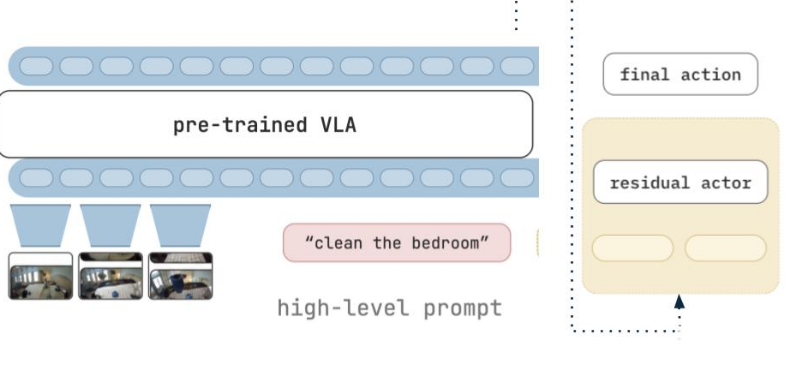 Adaptation of Generalist Robot Policies with Minimal DataShreyas Kowshik, Sreyas Venkataraman, Leo Wang, Niharika Pant, Max Simchowitz, and Aviral KumarIn RSS 2026 Workshop on Reinforcement Learning for Vision-Language-Action Models (RL4VLA), Jul 2026
A central goal of robot learning is to move beyond task-specific human data collection toward robots that improve through autonomous interaction. Yet fully autonomous learning remains difficult with current policies: sparse rewards and weak zero-shot exploration make it unlikely that a robot will discover successful behavior from scratch. We study minimal-data adaptation, a regime in which a pretrained robot policy must learn a new task from as little as one demonstration followed by autonomous online interaction. This setting minimizes task-specific supervision while testing whether pretrained policies provide enough structure to make reinforcement learning tractable. We present midas, an offline-to-online RL framework that first anchors a pretrained VLA to the target task with few-demo behavior cloning, then improves it through value-based online residual RL. Across LIBERO and RoboCasa, midas recovers strong task performance from as little as one demonstration, substantially outperforming baselines and generalizing beyond demonstrated conditions. To the best of our knowledge, this is the first demonstration of reliable robot policy adaptation from a single task demonstration. We further validate midas on bimanual YAM hardware, where it learns effective behaviors with roughly six hours of autonomous interaction.
@inproceedings{kowshik2026midas, title = {Adaptation of Generalist Robot Policies with Minimal Data}, author = {Kowshik, Shreyas and Venkataraman, Sreyas and Wang, Leo and Pant, Niharika and Simchowitz, Max and Kumar, Aviral}, booktitle = {RSS 2026 Workshop on Reinforcement Learning for Vision-Language-Action Models (RL4VLA)}, year = {2026}, month = jul, } - CMU
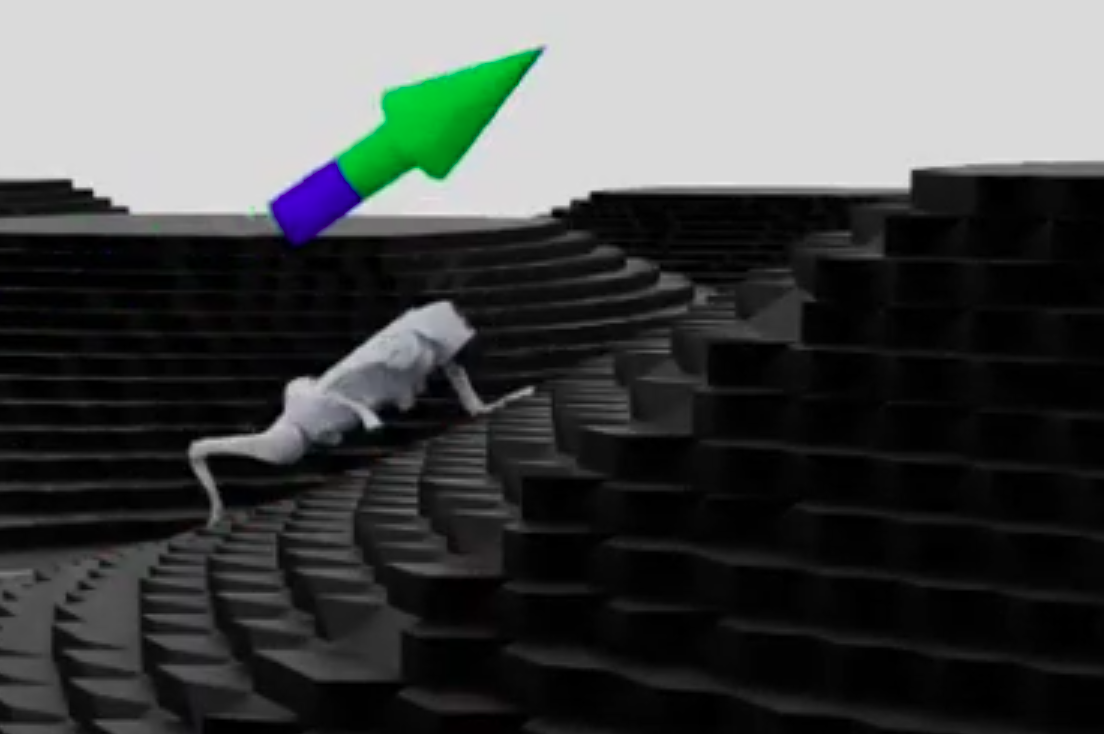 Quadrupedal Slope Climbing via Deep Reinforcement LearningLeo WangMeeting of the Minds 2026, Carnegie Mellon University Undergraduate Research Symposium , Apr 2026Oral presentation. Mentors: David Ologan, Aaron Johnson (Robomechanics Lab)
This project investigates the use of reinforcement learning (RL) to enable quadruped robots to climb steep cliffs with inclines exceeding 45°. Inspired by the remarkable agility of mountain goats, this work aims to replicate their dynamic climbing strategies on robotic platforms, with applications in search and rescue, mountainous exploration, and disaster response. The quadrupedal robot is trained in a simulation environment, where it climbs moderate incline challenges with progressively increased difficulty through curriculum learning. Early experiments revealed limitations in learning stability. However, modifications such as removing overly constraining penalties, revising terrain design, and increasing the observation variables of the robot have led to partial success: the policy learns to ascend shallow ridges (20°) and displays glimpses of more dynamic movement. These preliminary results suggest that with task-specific design and training, RL holds strong promise for teaching robots novel and extreme locomotion behaviors like cliff climbing. Future work includes incorporating LiDAR as a sensory modality, incorporating recurrent networks for slope estimation, and improving interpretability of learned policies.
@misc{wang2026quadruped, title = {Quadrupedal Slope Climbing via Deep Reinforcement Learning}, author = {Wang, Leo}, howpublished = {Meeting of the Minds 2026, Carnegie Mellon University Undergraduate Research Symposium}, year = {2026}, month = apr, note = {Oral presentation. Mentors: David Ologan, Aaron Johnson (Robomechanics Lab)}, } - CMU
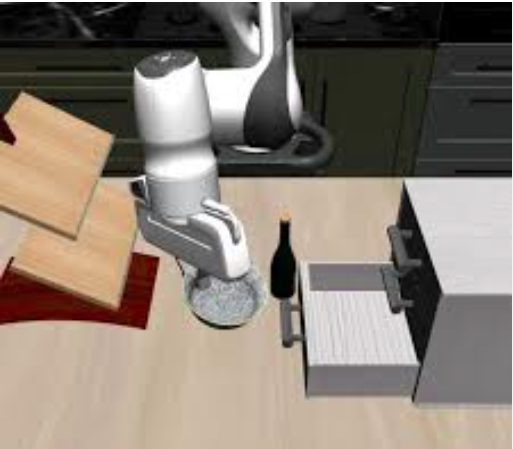 Steering Vision Language Action Models with Mechanistic InterpretabilityLeo Wang, Ashutosh Panda, Varun Chandra, and Grace KaimburiCourse project report, 11-785 Introduction to Deep Learning, Carnegie Mellon University , Apr 2026Presented in front of CMU ML professors and students of 11-785 Introduction to Deep Learning
Vision-Language-Action (VLA) models promise general-purpose robots that can follow language instructions, yet their black-box nature impedes robustness and safety. We apply mechanistic interpretability techniques to SmolVLA, a compact open-source VLA, to establish causal links between neurons and robot behavior. First, we project feedforward layer value vectors into vocabulary space, revealing that semantically meaningful concepts (e.g., speed) are concentrated in later layers (23–29), a right-shifted distribution that contrasts with prior findings in larger models. We then identify specific neurons whose top tokens robustly encode "fast" and "slow" and design both single-neuron and multi-neuron cluster steering interventions. Steering is performed by clamping selected neuron activations at inference time. We evaluate two experimental sweeps on the LIBERO benchmark: a lean sweep of single-neuron interventions, and a cluster sweep using top-5 semantically aligned neurons across α ∈ 2, 5, 10. Single-neuron steering is ineffective at α=10, performing no better than random injection on end-effector speed. Cluster steering on Task 0 consistently outperforms matched random injection but remains below the unsteered baseline, suggesting that per-step activation clamping introduces noise that partially disrupts the policy. On a second task (Task 1), cluster steering at α=5 achieves a ∼6% speed increase over both the unsteered baseline and random injection (Cohen’s d ≈ +0.3), providing the first clean positive signal in our sweep. The effect is non-monotonic in α: it peaks near α=5 and inverts above α=10, consistent with polysemantic value vectors whose non-speed content dominates at high amplitudes. Our work provides a counter-narrative for interpreting and steering smaller VLAs, showing both where FFN interpretability techniques succeed and where they are limited by model scale.
@techreport{wang2026steering,
  title = {Steering Vision Language Action Models with Mechanistic Interpretability},
  author = {Wang, Leo and Panda, Ashutosh and Chandra, Varun and Kaimburi, Grace},
  institution = {Carnegie Mellon University},
  note = {Presented in front of CMU ML professors and students of 11-785 Introduction to Deep Learning},
  year = {2026},
}